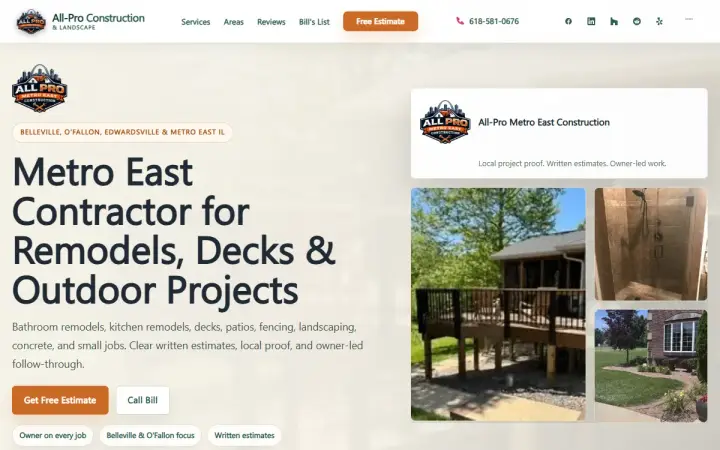
The implementation organizes a public route from service and location discovery to project context and an estimate or contact action. That structure can be inspected. A before-and-after commercial baseline cannot.
The work is presented here because it shows how Tony approaches a fragmented customer path: clarify what the business does, organize the information a prospective customer needs, make the next action visible and give the business a place to measure what happens next.
A built system is evidence of implementation. It is not, by itself, evidence of a business outcome.
What the public implementation shows
Service and location structure
The public site organizes service information and geographic context into navigable pages. The observable fact is the information architecture—not whether any page holds a particular search position.
Project context and business proof
Public project images, service descriptions and business contact information give a visitor material to inspect before deciding whether to inquire. All-Pro controls its customer work and business claims.
Call, form and estimate paths
The interface gives visitors visible routes to call, submit information or begin an estimate conversation. Those routes establish an intake design; they do not establish how many qualified inquiries arrived or what happened after submission.
Responsive, crawlable presentation
The publicly available pages can be reviewed across screen sizes and contain navigation, page metadata and structured content. Performance, index coverage and search visibility require dated source-system evidence before they can be reported as outcomes.
Evidence ledger
Awaiting baseline- Business problem
- Services, locations, project proof and homeowner intake needed one clearer public path.
- System built
- A responsive service and location architecture with project context, call, form and estimate routes.
- Tony’s role
- Customer-path and revenue-systems builder for the published implementation shown here.
- Human owner
- All-Pro controls customer work and business decisions. Tony owns this first-party description of his implementation work.
- Evidence available
- Public website pages, a dated public screenshot, TonyBeal.net’s evidence scorecard and FieldKnown’s public first-party work record.
- Outcome status
- Awaiting baseline. No verified ranking, lead, revenue or ROI outcome is published.
- Permission status
- Customer publication permission is not recorded. This record is limited to facts visible on public webpages.
- Known limitation
- First-party documentation shows authorship and implementation scope; it is not independent validation or customer endorsement.
What this record does not establish
- It does not establish Google index coverage, rankings or map visibility.
- It does not establish qualified lead volume, response time, estimate conversion or won work.
- It does not establish revenue, return on investment or attribution to one page or system.
- It does not establish independent validation, endorsement or recorded customer publication permission.
- It does not guarantee that the same architecture will produce the same result for another business.
The next responsible proof step
- Record customer permission for any non-public facts or outcome publication.
- Create a dated baseline from approved Search Console, analytics, form, CRM and revenue sources.
- Define each metric and its attribution limits before comparing periods.
- Have the business owner review the finding and the language used to describe it.
- Publish only the evidence and outcomes that survive that review.
Until those steps are complete, this implementation remains useful as inspectable work—not as proof of rankings, leads or revenue.
Public sources
- All-Pro Metro East Construction public website
- TonyBeal.net evidence scorecard
- FieldKnown public first-party work record
Sources reviewed August 23, 2026. Public availability can change. None of these links creates an independent outcome verification.

About Tony Beal
Tony is a Revenue Systems Builder based in Greater St. Louis who works nationwide by video. All-Pro is one documented implementation, not the boundary of Tony’s market. Inspect Tony’s experience or review the evidence ledger.